For years, nuclear fusion has felt like a promise stuck on repeat. Always close. Never quite there. That changed when China’s so-called Artificial Sun pulled off something most physicists believed could not happen.
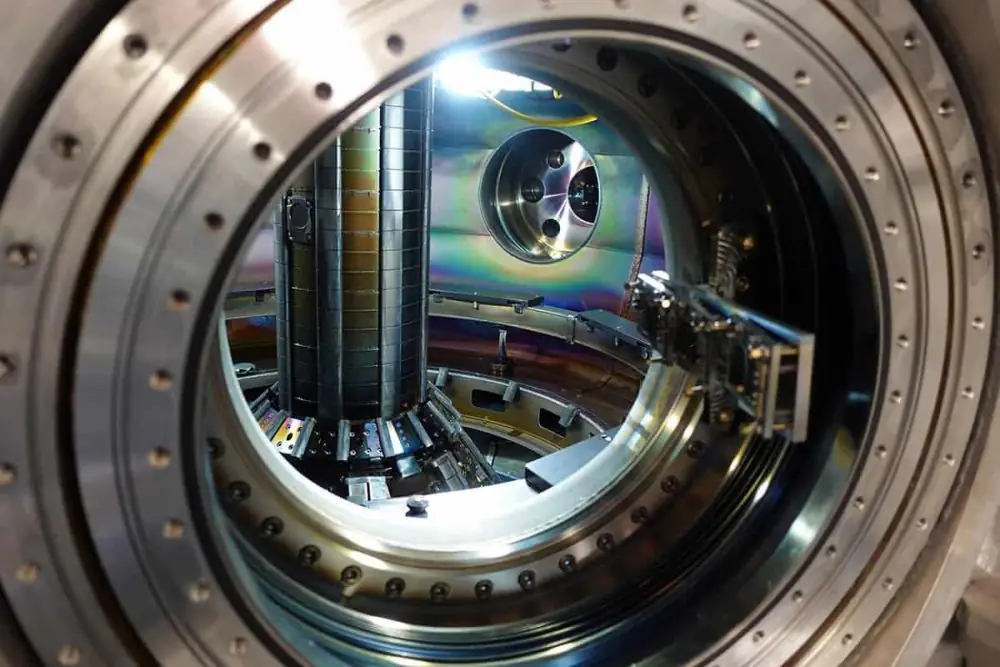
At the heart of this breakthrough sits the Experimental Advanced Superconducting Tokamak, better known as EAST. Inside this machine, Chinese scientists pushed fusion plasma past a density limit that textbooks treated as a hard stop. The result is a cleaner, stronger reaction and a serious shift in how fusion reactors may be designed from here on out.
The Density Wall That Stopped Fusion Cold
For decades, tokamaks were limited by an upper plasma density rule. Push the fuel too hard, and the plasma would shake itself apart. Instabilities would crash into the reactor walls, shut down the reaction, and risk damage. This ceiling kept fusion power stuck at modest levels, far from what a real power plant needs.
That rule just broke. At EAST, researchers managed to run plasma at densities far beyond the accepted limit. The reactor stayed stable. No violent collapse. No meltdown. This is what scientists now call a density-free regime. Fusion output rises fast when density climbs, so this matters more than almost any single fusion milestone before it.
How China’s ‘Artificial Sun’ Pulled It Off?
The trick was not brute force. It was controlled from the very first second. EAST scientists focused on how plasma touches the metal walls of the reactor before things heat up.
They carefully tuned the starting fuel pressure and used electron cyclotron resonance heating to shape the plasma early. That reduced harmful feedback between the plasma and the walls. Instead of chaos, the system organized itself. The plasma stayed calm even as density climbed higher than theory once allowed.
This success backs a newer idea called plasma wall self-organization. It says the wall is not just a passive container. It is part of the system. Handle that relationship right, and the old density limits no longer apply.
This Changes the Fusion Timeline

Until now, fusion research has focused heavily on higher temperatures and stronger magnets. Density stayed boxed in by fear of instability. EAST showed that the box was partly imaginary. That unlocks higher output without massive new machines or exotic physics.
It also reshapes how future reactors may be built. Designers can aim for smaller, more powerful systems instead of massive facilities, chasing incremental gains. That alone could shave years off the path to usable fusion energy.
It is essential to note here that better plasma is useless if the reactor walls cannot survive it. Fusion interiors face extreme heat, neutron damage, and constant particle bombardment. For a long time, wall materials lagged behind plasma science.
Now, that gap is closing. Reactors are moving away from carbon and beryllium and toward tungsten. Tungsten does not soak up fuel like carbon does, which keeps reactions cleaner. The challenge is that even tiny tungsten impurities can cool plasma fast.
France’s WEST reactor proved tungsten can handle the heat by holding plasma at 50 million degrees Celsius for six straight minutes. Korea’s KSTAR hit 100 million degrees with a tungsten divertor. These results directly support plans at the International Thermonuclear Experimental Reactor, which has committed to a full tungsten interior.
Even tungsten is not perfect. Researchers are already building what comes next. Labs are testing tungsten ceramic blends and alloys designed to resist cracking and radiation damage. Universities in the U.S. and Europe are pushing microstructured materials that stay stable under neutron bombardment. These materials could last longer and reduce